

Digital Marketing Strategies for Hospitals: A Complete Guide to Online Growth | NGR Digital World

The way patients find hospitals has changed. Before booking an appointment, many people search on Google, read reviews, compare medical services, and visit hospital websites. They want to understand the available treatments, doctors, facilities, location, and appointment process before making a decision.
A hospital’s digital presence plays an important role in helping people discover its services and find reliable healthcare information online. It helps patients discover healthcare services, find reliable information, and contact the right medical facility when they need care.
This is where digital marketing becomes valuable.
A well-planned digital marketing strategy for hospitals combines search engine optimization (SEO), website development, social media marketing, local search visibility, useful content, and online reputation management. These activities help hospitals connect with relevant audiences while communicating their services clearly and responsibly.
In this guide, we will explore practical digital marketing strategies for hospitals, explain how healthcare providers can improve their online visibility, and show how NGR Digital World can help healthcare businesses strengthen their digital presence.
Why Digital Marketing Matters for Hospitals
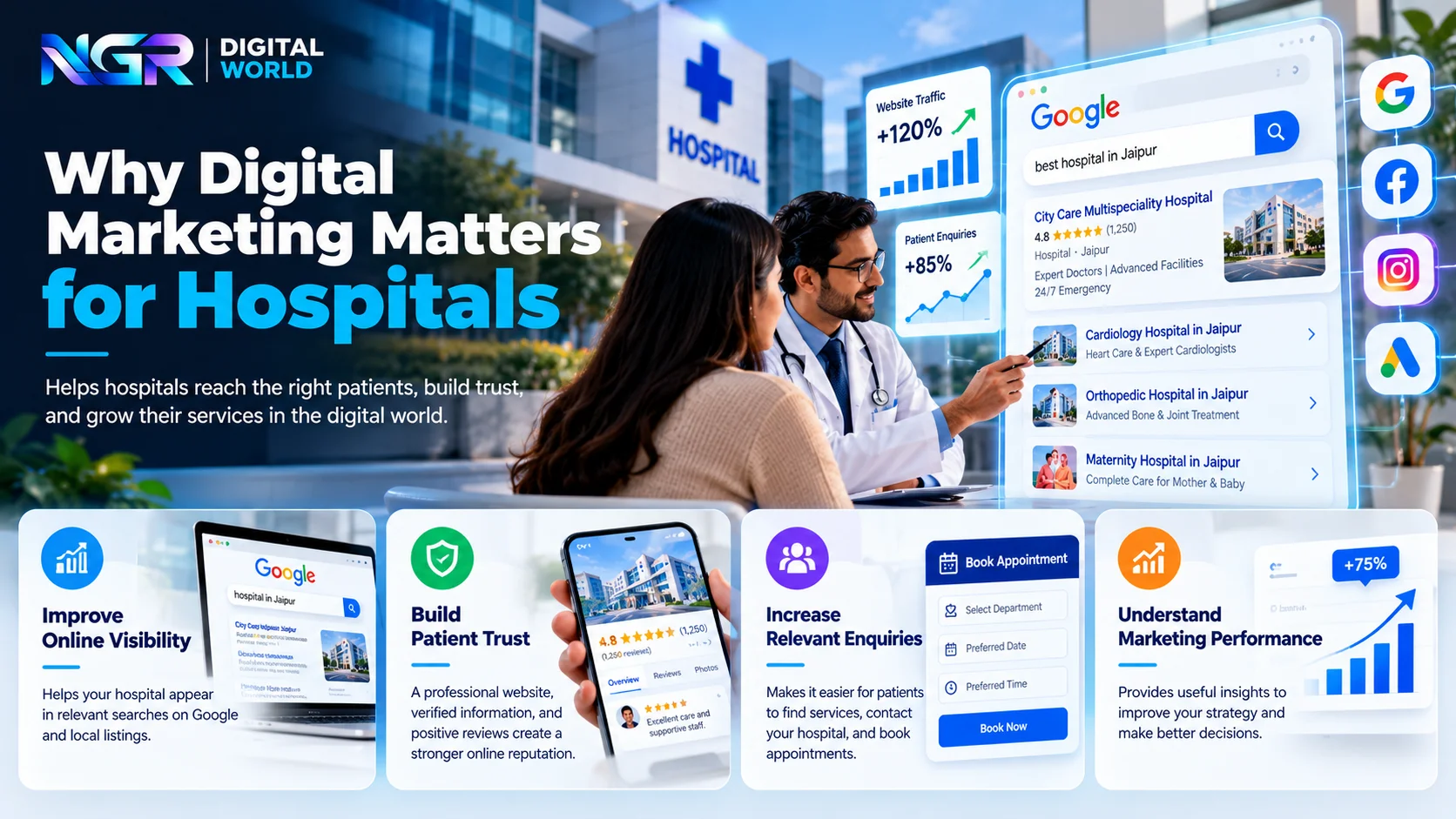
Patients often begin their healthcare journey online. They may search for a nearby hospital, look for a specialist, check consultation hours, or compare available facilities.
If your hospital does not appear in relevant searches or has an outdated website, potential patients may struggle to find the information they need.
Digital marketing helps hospitals address this problem through several important activities.
1. Improve Online Visibility
Search engine optimization When someone searches for a medical facility or a particular treatment, SEO helps search engines identify relevant pages from your hospital’s website. Local search optimization can also help people find nearby facilities, check directions, and access contact details.
For example, someone may search for a hospital in Jaipur, a nearby diagnostic centre, or a specialist consultation. A well-optimized website and accurate business profile can make it easier for people to discover your facility.
2. Build Patient Trust
Healthcare decisions require careful consideration. Patients want to know whether a hospital communicates clearly, maintains professional standards, and provides relevant information.
A professional website, transparent service details, accurate doctor profiles, and genuine patient reviews can help create a more trustworthy online presence.
3. Increase Relevant Enquiries
Digital marketing can help people find appointment details, department information, contact numbers, and available services.
Clear calls to action, such as “Book an Appointment” or “Contact Our Hospital,” make the next step easier.
However, marketing should focus on helping people access appropriate healthcare services rather than promising medical outcomes.
4. Understand Marketing Performance
Digital analytics can show which pages people visit, how they discover your hospital, and which channels generate calls or appointment enquiries.
This information helps hospital management make better decisions about marketing budgets and website improvements.
1. Build a Professional Hospital Website
Your website is often the first detailed introduction people receive to your hospital. It should be easy to navigate, mobile-friendly, informative, and accessible.
A poorly designed website can make it difficult for visitors to find essential information, even if the hospital provides quality services.
Essential Website Features for Hospitals
A useful hospital website should include:
- Home page: Introduce the hospital, its key departments, and major services.
- About page: Explain the hospital’s background, facilities, and approach to patient care.
- Doctor profiles: Display verified qualifications, specialties, and consultation information.
- Department pages: Provide clear details about each medical department and its services.
- Appointment information: Explain how patients can request or schedule appointments.
- Contact page: Include the address, phone number, directions, and operating hours.
- Emergency information: Clearly explain how people should contact the hospital for urgent assistance.
Why Mobile-Friendly Design Matters
Many people search for healthcare services using smartphones. Your website should load quickly, display text clearly, and make important buttons easy to tap.
A mobile-friendly website should also avoid unnecessary pop-ups and confusing navigation.
Businesses looking for website design and development for hospital companies should prioritize usability, accurate information, accessibility, and patient privacy—not just visual appearance.
2. Use Hospital SEO to Improve Google Visibility
Search engine optimization helps search engines understand your website and helps people discover relevant healthcare information.
A hospital SEO strategy should focus on useful service pages, accurate local information, clear website structure, and content that answers genuine patient questions.
Conduct Healthcare Keyword Research
Start by identifying the services people are likely to search for.
Examples include:
- Hospital in Jaipur
- Multispecialty hospital in Jaipur
- Orthopedic doctor in Jaipur
- Diagnostic services near me
- Hospital appointment in Jaipur
- Maternity hospital in Jaipur
Choose keywords based on the actual services your hospital provides. Avoid creating pages for treatments or specialties that are not available at your facility.
Optimize Individual Service Pages
Each major department should have a dedicated page explaining its services, relevant facilities, appointment process, and contact details.
For example, a cardiology page could describe the department’s scope, available consultation services, and how patients can contact the hospital.
Keep medical information accurate and have qualified healthcare professionals review content where appropriate.
Improve Technical SEO
Technical SEO helps search engines crawl and understand your website.
Important tasks include:
- Creating a logical website structure.
- Improving page loading speed.
- Using descriptive page titles and URLs.
- Adding relevant internal links.
- Maintaining an XML sitemap.
- Fixing broken links and indexing problems.
- Add structured data only when it matches the actual content and details displayed on your pages.
Working with a hospital SEO consultant can help you uncover website problems, strengthen important department pages, and build a focused plan for improving search visibility over time.
3. Strengthen Local SEO for Your Hospital
Local SEO is especially important for hospitals because many patients look for healthcare services in a specific city or nearby area.
A strong local presence helps people find your location, contact details, and available services.
Optimize Your Google Business Profile
Your Google Business Profile is another important part of local discovery. Make sure your hospital has a verified profile and regularly review its address, phone number, opening hours, and service details to keep the information accurate.
Make sure the profile includes:
- The correct hospital name and address.
- A verified contact number.
- Accurate opening hours.
- Relevant healthcare categories.
- The official website.
- Appropriate photographs of the facility.
- Updated information about available services.
Avoid adding misleading claims or using irrelevant business categories to attract more searches.
Maintain Consistent Business Information
Your hospital’s name, address, and phone number should be consistent across your website and relevant business directories.
Incorrect addresses or outdated phone numbers can confuse patients and reduce confidence.
Encourage Genuine Reviews
Patients may use reviews to understand other people’s experiences with a hospital.
Invite patients to leave honest feedback without pressuring them to provide positive reviews. Respond professionally to feedback and avoid revealing patient information in public replies.
Privacy matters: Never confirm someone’s patient status or discuss their treatment in a public review response.
4. Create Helpful Healthcare Content
Content marketing helps hospitals answer questions before patients contact them. It can also support SEO by providing useful information about services and common healthcare concerns.
Instead of publishing only promotional graphics, create content that answers genuine patient questions.
Blog Topics Hospitals Can Consider
- How to Prepare for a Hospital Appointment
- Questions to Ask Before Choosing a Specialist
- Understanding Common Diagnostic Tests
- When to Contact a Healthcare Professional
- What Patients Should Know Before a Planned Procedure
- How to Find the Right Hospital Department
These topics should be developed with appropriate medical review. Health content must be accurate, understandable, and updated when recommendations or services change.
Follow Google’s E-E-A-T Principles
Google uses the concepts of Experience, Expertise, Authoritativeness, and Trustworthiness when evaluating the quality of content, particularly for topics that can affect health and well-being.
Hospitals can support these principles by:
- Identifying qualified medical reviewers.
- Displaying accurate professional credentials.
- Citing reliable medical sources where appropriate.
- Including publication and review dates.
- Correcting outdated information.
- Avoiding unsupported treatment claims.
E-E-A-T is not a single ranking factor or a guarantee of higher rankings. It is a useful framework for creating responsible healthcare content.
5. Use Social Media Marketing for Hospitals
Social media allows hospitals to share updates, explain services, introduce medical departments, and publish educational information.
The goal should be to communicate useful information and maintain a professional relationship with the community.
Content Ideas for Hospital Social Media
Educational posts: Share general health information reviewed by qualified professionals.
Doctor introductions: Present verified professional backgrounds and specialties.
Hospital facilities: Show relevant facilities, equipment, and services accurately.
Appointment information: Explain booking procedures, consultation timings, and contact options.
Awareness campaigns: Publish appropriate content for health awareness days and community initiatives.
Frequently asked questions: Answer common questions about hospital services, appointment procedures, and visiting arrangements.
Maintain a Responsible Social Media Strategy
A consistent posting schedule is helpful, but quality matters more than publishing every day.
Avoid presenting general information as personalized financial or medical advice. For healthcare marketing, never suggest that a general social media post can replace an individual medical assessment.
Protect patient confidentiality. Obtain appropriate consent before publishing identifiable patient photographs, testimonials, or treatment-related stories.
Social media marketing of hospitals should build understanding and trust—not exploit fear or make unrealistic promises.
6. Consider Paid Advertising for Relevant Services
Paid advertising can help hospitals reach relevant audiences and promote specific services.
For example, a hospital may use search advertising to make an available department easier to find or promote a legitimate health-awareness programme.
However, healthcare advertising requires careful planning. Platform policies, local laws, professional standards, and restrictions on sensitive health information may apply.
Google Ads for Hospital Services
Search campaigns can target relevant service-related searches. A useful campaign should have:
- Clear and accurate advertising copy.
- Relevant landing pages.
- Correct contact information.
- A suitable geographic target.
- A defined budget.
- Conversion tracking configured with privacy in mind.
Do not use misleading claims, guarantee treatment results, or imply that a particular patient has a medical condition.
Measure the Right Results
Do not judge campaigns only by clicks or impressions.
Where appropriate, track calls, appointment requests, form submissions, and other meaningful actions. Ensure tracking practices comply with applicable privacy requirements and do not unnecessarily collect sensitive health information.
Paid advertising should complement a strong website and reliable service information rather than compensate for an unclear patient experience.
7. Improve Online Reputation Management
A hospital’s online reputation can influence how people evaluate its services.
People may read reviews, check official responses, and look for consistent information before contacting a facility.
Reputation management should therefore be part of the hospital’s wider digital marketing strategy.
Practical Reputation Management Steps
- Monitor reviews on relevant platforms.
- Respond politely and professionally.
- Thank reviewers for constructive feedback.
- Avoid arguing with reviewers online.
- Never disclose confidential patient information.
- Investigate recurring service-related concerns internally.
- Correct inaccurate information through the appropriate platform process.
Do not buy reviews, fabricate testimonials, or selectively manipulate feedback. Genuine and ethical reputation management is more sustainable than shortcuts.
8. Make Appointment Booking Simple
Generating website visitors is only one part of digital marketing. Patients must also be able to understand how to contact the hospital or request an appointment.
Review the entire journey from search result to enquiry.
Ask yourself:
- Can visitors find the phone number quickly?
- Is the appointment button easy to identify?
- Does the booking form work on mobile devices?
- Are required fields limited to what is necessary?
- Does the patient receive a clear confirmation?
- Can visitors find the hospital location and timings?
Use simple calls to action such as “View Departments,” “Contact Our Hospital,” or “Request an Appointment.”
Collect only the information necessary for the intended purpose, and protect submitted information with appropriate security measures.
9. Use Email and WhatsApp Communication Responsibly
Email and WhatsApp can help hospitals share administrative updates, appointment reminders, and service information when used appropriately.
For example, a hospital may send appointment confirmations or reminders to people who have agreed to receive such communications.
Before sending promotional messages, consider consent, applicable communication rules, and the recipient’s preferences.
Avoid sharing sensitive medical details through insecure or inappropriate channels. Provide a clear way for people to manage their communication preferences.
These channels should improve communication, not overwhelm patients with frequent promotional messages.
10. Track Performance and Improve Your Strategy
Digital marketing works best when hospitals review performance and make improvements based on reliable data.
A simple reporting process can help identify which activities deserve more attention.
Important Metrics to Monitor
| Metric | What It Helps You Understand |
|---|---|
| Organic website traffic | Whether search visibility is improving |
| Local search performance | How people discover the hospital locally |
| Service-page engagement | Whether visitors find pages useful |
| Appointment enquiries | Whether people are taking the next step |
| Qualified calls | Whether enquiries relate to relevant services |
| Advertising cost per enquiry | How efficiently campaigns generate enquiries |
| Website conversion rate | How often visitors complete a desired action |
Use analytics tools with suitable privacy controls. Avoid sending identifiable patient information or sensitive health details to advertising and analytics platforms unless the relevant use is lawful and appropriately configured.
Review results monthly, investigate changes, and test practical improvements. Not every increase in traffic means better outcomes; relevant enquiries and a good patient experience are more meaningful measures.
11. How to Choose a Digital Marketing Agency for a Hospital
Choosing the right marketing partner requires more than comparing prices or promises.
Hospitals should look for a team that understands local search, website usability, content quality, advertising policies, and the importance of patient privacy.
Before hiring an agency, ask:
- Have you worked with healthcare or other trust-sensitive businesses?
- How will you approach local SEO?
- Who reviews healthcare-related content?
- How do you measure enquiries and campaign performance?
- How do you protect website and customer data?
- What will monthly reports include?
- Which activities are included in the proposed budget?
Be cautious of agencies that guarantee first-page rankings, promise a fixed number of patients, or recommend misleading marketing practices.
Should You Hire a Digital Marketing Freelancer or an Agency?
A freelancer may be suitable for a smaller project, such as basic SEO, blog writing, website updates, or social media management.
An agency may be more appropriate when a hospital needs several services working together, including technical SEO, website development, paid advertising, content production, and analytics.
If you plan to hire a digital marketing freelancer for a hospital, clearly define the scope of work, access permissions, reporting expectations, and responsibilities for protecting confidential information.
The best option depends on your hospital’s goals, budget, internal team, and required level of support.
How NGR Digital World Can Support Hospital Marketing
NGR Digital World provides digital-focused services that can help businesses strengthen their online presence. For hospitals, the right approach begins with understanding the facility’s actual services, target location, audience needs, and existing website.
Potential areas of support include:
- Website design and development: Creating clear, mobile-friendly websites with useful department pages and contact options.
- SEO and local SEO: Improving website structure, service-page relevance, and local search information.
- Content marketing: Planning helpful articles and service content around genuine audience questions.
- Social media marketing: Developing consistent, professional content for relevant platforms.
- Paid advertising support: Planning campaigns around suitable services and measurable objectives.
- Performance reporting: Reviewing available data and identifying practical opportunities for improvement.
Businesses searching for a digital marketing agency in Jaipur can evaluate NGR Digital World based on their requirements, service scope, portfolio, and reporting process.
The aim should be to build a useful digital presence that helps people find accurate information and contact the hospital through appropriate channels.
A Simple 90-Day Hospital Digital Marketing Plan
Hospitals do not need to launch every marketing activity at once. A phased plan makes it easier to establish a strong foundation and evaluate progress.
Days 1–30: Build the Foundation
- Review the existing website and local business listings.
- Check contact details, operating hours, and service information.
- Identify important service-related search terms.
- Fix major mobile usability and technical SEO issues.
- Review privacy notices and enquiry forms.
Days 31–60: Improve Visibility
- Optimize priority department pages.
- Publish useful, medically reviewed content.
- Improve the Google Business Profile.
- Create a consistent social media content plan.
- Establish baseline website and enquiry measurements.
Days 61–90: Measure and Refine
- Review search visibility and website engagement.
- Evaluate the quality of appointment enquiries.
- Test improvements to important landing pages.
- Consider suitable paid campaigns if the foundation is ready.
- Prepare a report with findings and next steps.
This is a planning framework, not a promise of rankings or patient growth within 90 days. Results depend on competition, implementation quality, available resources, and other factors.
Common Hospital Digital Marketing Mistakes to Avoid
Even a well-funded marketing campaign can underperform when important details are overlooked.
Avoid these common mistakes:
Using one generic page for every service: Dedicated, informative department pages usually provide a clearer experience.
Ignoring local SEO: Inaccurate business details can make it harder for people to contact the hospital.
Publishing unverified medical content: Healthcare information should be reviewed and supported by appropriate evidence.
Focusing only on followers: Social media growth does not automatically translate into useful enquiries.
Making exaggerated claims: Avoid guaranteed outcomes, misleading comparisons, or unsupported superiority statements.
Neglecting patient privacy: Website forms, testimonials, photographs, and analytics must be handled responsibly.
Failing to measure enquiries: Website traffic alone does not explain whether the marketing strategy is meeting its objectives.
Addressing these issues creates a stronger foundation for long-term digital growth.
Conclusion
Digital marketing can help hospitals improve online visibility, communicate their services clearly, and make it easier for people to find relevant healthcare information.
The most effective approach combines a professional website, local SEO, useful content, responsible social media marketing, suitable advertising, and ongoing performance measurement.
Hospitals should focus on accuracy, accessibility, patient privacy, and trust at every stage of the digital journey. These priorities support a better experience for people searching for healthcare services.
For hospitals seeking digital support, NGR Digital World can be considered as a potential partner for website development, SEO, content, and digital marketing services based on the hospital’s specific needs.
The key principle is simple: do not focus only on attracting website visitors. Help people find the right information, understand your services, and contact your hospital with confidence.
Frequently Asked Questions
1. What is digital marketing for hospitals?
Digital marketing for hospitals includes SEO, website development, local search optimization, social media, content marketing, and online advertising to improve visibility and help people find relevant healthcare services.
2. How can a hospital attract more online enquiries?
A hospital can improve its website, optimize relevant service pages, maintain accurate local listings, publish useful content, and make contact and appointment options easy to find. Results depend on the quality and relevance of these activities.
3. Why is local SEO important for hospitals?
Local SEO helps people discover nearby healthcare facilities, view accurate contact information, find directions, and explore relevant services.
4. Should hospitals invest in social media marketing?
Social media can help hospitals share educational content, introduce departments, communicate service updates, and answer general questions. Content should be accurate, professional, and respectful of patient privacy.
5. How do I choose a digital marketing agency in Jaipur for a hospital?
Review the agency’s services, relevant experience, strategy, reporting methods, data-handling practices, and pricing. Avoid guarantees of rankings or patient numbers.
6. How long does hospital SEO take to show results?
SEO is a long-term process. Improvements may take several months, depending on competition, website condition, content quality, and implementation. No agency can reliably guarantee a specific ranking or timeline.
7. What should a hospital website include?
A hospital website should provide accurate department information, verified doctor profiles, contact details, location, operating hours, appointment instructions, accessibility features, and clear privacy information.
